Sometimes in genealogy, you know you’re looking at gold, even if you can’t fully extract the value. That’s how I felt when I found my 4th-great-grandparents’ January 1815 marriage record in Dritschmin (Drzycim) Parish in West Prussia.
Matthias ROMANOWSKI, often written as ROMANIECKI in Prussian records, married Marianna PIOTROWSKA on January 8, 1815. That much was clear. There was a lot more though, written in Latin – a potential treasure trove of info:
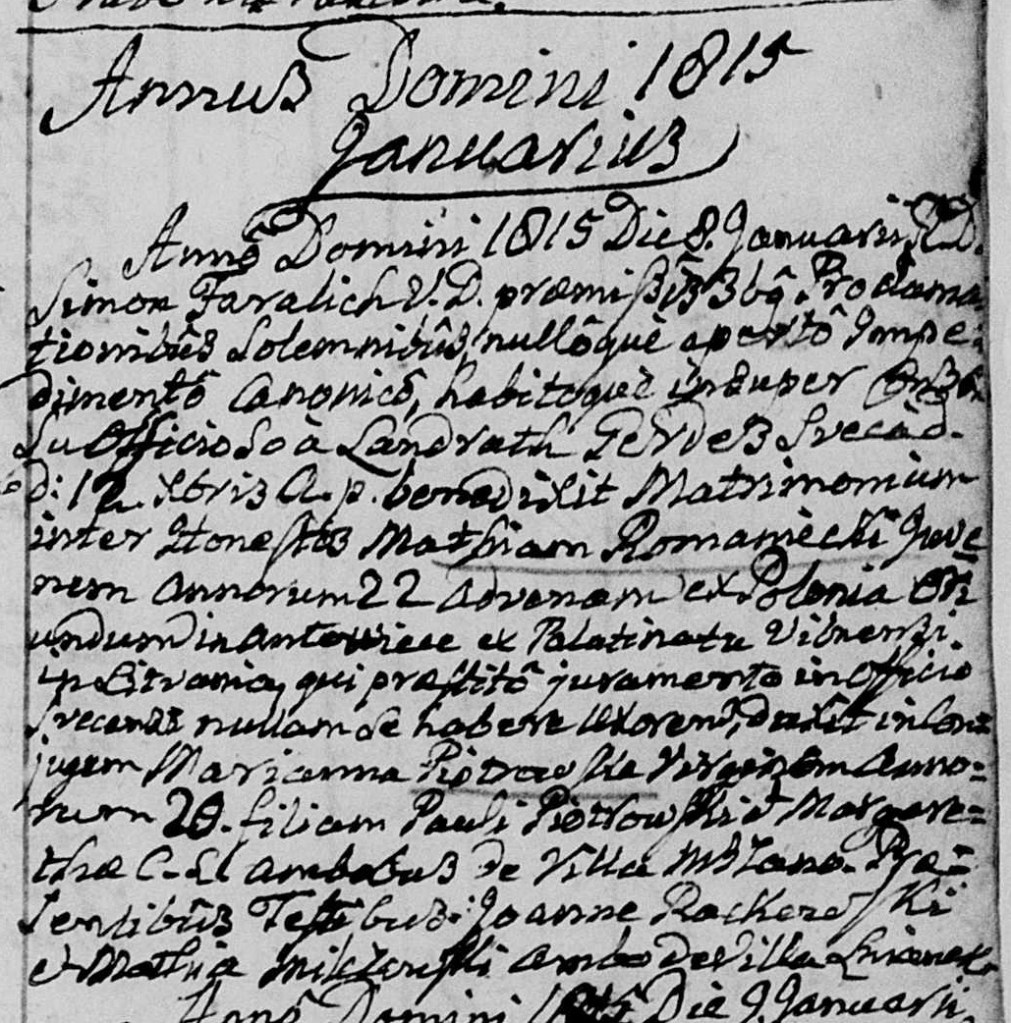
The groom’s age is very clear: 22 years old. The bride’s age seems to be 20. Her parents’ names are provided as Paul PIOTROWSKI and Margaretha, both of the village of Mszano. (This lined up nicely, as Matthias and Marianna’s son Martin ROMANOWSKI was born in Mszano [Marienfelde] in Oct. 1815.)
Where Was Matthias From?
From there, lots of text, but not exactly obvious. One issue is legibility. It is not the most legible handwriting. Then there’s the question of translation. I know that “ex” means “of”. Why does Matthias have multiple “ex”‘s after his name? He has “ex Polonia” (Poland) but also “ex Palatinate,” which I initially interpreted as the Palatinate (Pfalz) region of Germany.
“in Antowiese ex Palatinate”
My first theory is that it was referring to a place called Antowiese in the Pfalz. “Anto” may be related to the Latin “ante” meaning before. The Wiese is a well-known river that runs along the Pfalz region. He was from “before the Wiese”? Maybe geographically east of it, since West Prussia is east of that geographically?
Revisiting the record many months later, I realized something stunning. The phrase “in Litvania” – Lithuania! That changed everything, as now I saw “ex Palatinate Vilnenzi”(?).. in Lithuania. Googling Palatinate + Lithuania revealed that a Palatinate is a voivodeship (type of territory) in Lithuania. When looking at a list of Palatinates, there was one called Vilnius! Re-evaluating the text, it can definitely be a form of Vilnius that is Latinized.
But what about Antowiese? So here’s where AI came into play.
AI Contextualized The Record
While AI isn’t perfect, it can be a great research assistant. I asked ChatGPT to first transcribe this document, and it did an excellent job of that. Then I asked for an English translation. Again very good. (Posted the transcriptions here.)
Based on the context, I asked AI for 3 possibilities for Antowiese connected to the Palatinate of Vilnius. The first option jumped out right away. Antaviliai is a village just 10 kilometers north of the city of Vilnius, within the Palatinate Vilnius.
ChatGPT explained the many elements at play for “Antowiese.” This includes Latinization and Germanization of place names. Given it was Prussia, this may account for the German-sounding -iese ending. It noted that similar historical documents had village names ending with -iese. Phoenetically, it was a good match.
It sure seems like it is Antaviliai, Palatinate Vilnius, Lithuania.
“ex Polonia oriundum”
Then AI provided a lot more historical context. The phrase “ex Polonia oriundum” means “originating from Poland”. (It says this was a common Latin phrase for that time period – I would have had no idea!) Most likely, this indicated cultural associations, as the Russian Empire took control of Vilnius in 1795. Vilnius was previously part of the Polish-Lithuanian Commonwealth and had plenty of links with Polish heritage. One could have been from there and said they were from Poland. Alternatively, Matthias may be stating he was Polish, or that he was born in a territory in historic Poland and then went to Vilnius.
I asked for reasons why Matthias may have moved to West Prussia from the Vilnius area. It had great insights and provided a very clear timeline:
- 1791: Polish-Lithuanian Commonwealth adopts its Constitution
- 1792: Catherine the Great of Russia leads a war against the Polish-Lithuanian Commonwealth
- Around this time, the birth of Matthias ROMANOWSKI, possibly in or near Vilnius
- 1793: Russia Empire claims control of Vilnius after the 2nd Partition of Poland
- 1794: The Kosciuszko Uprising, a major insurrection led by Tadeusz Kosciuszko against Russian and Prussian control. Vilnius was a center of the uprising.
- 1795: Polish-Lithuanian Commonwealth is fully dissolved and Vilnius officially becomes part of the Russian Empire
- 1803: Napoleonic Wars begin with profound impact across Europe
- 1812: Napoleon’s Army marches through Vilnius on its way to invade Russia
- Later in the year: Vilnius suffered significant destruction and hardship as Napoleon retreated, leaving the city in chaos
- 1814: Napoleon is defeated
It indicated that Matthias may have had military service; many soldiers became displaced around that time. This lines up well with his January 1815 marriage. It also noted that he may have left to explore economic opportunities. Or he might have had social connections with West Prussia. The European continent was undergoing so much change after the Napoleonic Wars.
AI Suggested Next Steps for Research
I asked for suggestions on what to do next to find Matthias in other records. It suggested to start with parish records in the Vilnius area to try to locate ROMANOWSKI references. It even came back with a specific parish, as there are many around Vilnius: St. Peter and Paul Catholic Church. It said this parish may include Antaviliai.
It advised me to follow up on the witnesses of the marriage. They could be relatives. They might also be connected socially or economically. Learning more about them could reveal clues. Perhaps one or both of them could even go back to Vilnius. This is something I haven’t checked yet, so it’s a good idea for follow up.
All in all, it brought the historical document to life and provided important context on my ancestor Matthias ROMANOWSKI. I’m not sure I would have found Antaviliai without AI. It is a tiny place. Previously, checking lists of Lithuanian places revealed nothing. Even asking a Lithuanian genealogy group provided no results. Now I have new avenues for research to pursue.
Here’s my line of descent from Matthias ROMANOWSKI:
Matthias ROMANOWSKI b. c1792 –> Martin ROMANOWSKI b. 1815 🇩🇪 –> Franz ROMANOWSKI b. 1851 🇩🇪 –> Eric ROMANE b. 1902 🇺🇸 –> Rita ROMANE b. 1933 🇺🇸 –> Patrick KANALLEY 🇺🇸 –> Craig KANALLEY 🇺🇸
 Craig Kanalley